

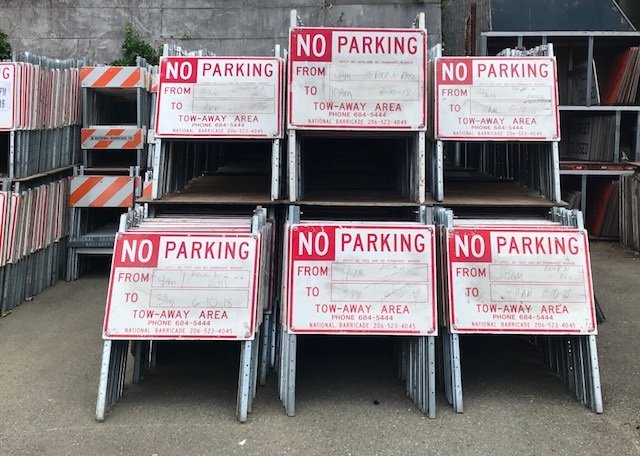
The parking spot you need for Tuesday’s delivery has to be signed by Saturday. Miss that window and the tow truck can’t do a thing for you.
Temporary no-parking is the least glamorous permit in Seattle and the one that derails the most schedules. Crews budget weeks for a street use permit and then lose a morning because nobody posted signs in time, or posted one where the rules require two.
We’ve been renting the signs and easels for this since 1951. Here’s how the timing, the placement, and the money actually work.
What a temporary no-parking zone is
A temporary no-parking zone — the city calls it a TNP — reserves curb space that would otherwise be open to the public. It’s what you use when a crane needs the lane, a moving truck needs the frontage, a dumpster needs a home for three days, or a film crew needs the block.
It is a separate permit from your street use or construction permit. Getting one approved does not get you the other. Contractors routinely discover this the week they mobilize.
The 72-hour rule, and the one everyone gets wrong
Signs have to go up 72 hours before the reservation starts — the rule is set out in the city’s Client Assistance Memo 2114. That is the number to plan around, and it’s the one that quietly kills Monday starts, because you’re posting on Friday.
Apply at least 24 hours ahead of when you want to post. Between the application and the posting window, a same-week TNP is realistic but a same-day one is not.
Placement: two signs per block, minimum
One sign is not a reservation. The city requires at least two signs per block so a driver approaching from either direction sees the restriction before they commit to the space.
Each sign has to show:
- A contact name
- A phone number that will be answered
- The start and stop times of the reservation
Signs go on reusable T-38 or T-39 easels, filled in with non-permanent marker or grease pencil so the same easel works the next job. That’s the standard we rent to, and it’s why the easel matters as much as the sign.
Peak-hour restrictions also still apply. A TNP does not override a rush-hour no-stopping lane — if the curb is restricted at 4 p.m. normally, it’s restricted at 4 p.m. with your permit in hand.
Signs, Easels & Work Zone Gear
What it costs
The fee depends on whether you’re taking paid parking or free parking, and where in the city you are. The application itself lives on SDOT’s temporary no parking page.
Free-parking areas carry no reservation fee. If the curb wasn’t earning the city money, reserving it doesn’t cost you for the space itself.
In paid areas, you are buying back the meter revenue. The rates below come from SDOT’s Client Assistance Memo 2114, which is the most recent schedule the city has published — it was last revised in January 2020:
| Area | Full 24 hours | Mon–Sat, 7am–6pm |
|---|---|---|
| Downtown core (CBD) | $27 per space, per day | $22 per space, per day |
| Outside the CBD | $20 per space, per day | $17 per space, per day |
On top of that there’s a one-time deployment fee of $18.50 per space.
Three things worth knowing about those numbers. They are per space, not per permit — a 60-foot work zone is several spaces and the math moves quickly. The schedule they come from is now several years old. And SDOT no longer publishes current TNP pricing on its permit pages at all: you are quoted fees by invoice once you apply. Treat the table as a planning baseline rather than a quote, and confirm the current rate with the SDOT permit counter before you budget a job.
One restriction that surprises people
In restricted parking areas, TNP permits are issued for trucks and commercial-plated vans — not passenger cars. If your plan was to hold a space with a crew member’s sedan, that isn’t what the permit is for.
How this fits with your traffic control plan
If your job is big enough to need a traffic control plan, the curb reservation is a line item on it, not a separate afterthought. The plan shows how the curb space is currently designated and what you’re doing to it.
Sequence that works: figure out the curb space you need, apply for the TNP at least 24 hours out, post 72 hours before the reservation, and have the signs and easels on hand before that clock starts — not the morning of.
Frequently asked questions
How far in advance do I have to post temporary no-parking signs in Seattle?
72 hours before the reservation begins. Apply for the permit at least 24 hours before you intend to post, and remember that signs can’t be installed or removed on weekends or holidays.
How many signs do I need?
At least two per block, so drivers see the restriction from either direction. Each has to show a contact name, a working phone number, and the start and stop times.
What happens if a car is already parked there?
If your signs went up on time, Parking Enforcement can act on it. If you posted late, the vehicle was legally parked and you have no recourse. This is the single best reason to post early rather than exactly on the deadline.
Do I need a TNP if the parking is free?
You still need the permit — you just won’t pay a reservation fee for the space. The deployment fee still applies.
Can I reuse the signs on the next job?
The easels, yes — that’s why the city specifies reusable T-38 and T-39 stands filled in with non-permanent marker. Renting them job to job is usually cheaper than owning them unless you’re running curb reservations constantly.
We’ll have the signs ready
Short-term or long-term, delivered to the site. We stock the no-parking signs and the T-38 and T-39 easels the city specifies, along with the cones, barricades and work zone gear that usually go with them.
Serving Seattle, Tacoma, the Eastside and Snohomish County since 1951 — three generations, three yards, fully licensed by the Washington State Department of Transportation, and 24-hour emergency response. Working outside the city? We cover King County and the rest of the Puget Sound region; see our rental program for delivery. More permit and work zone guides live in our resources library.
Need Curb Space Reserved This Week?
Call 206-523-4045 and we’ll get signs and easels on your job before the 72-hour clock starts.