

Most contractors find out they need a traffic control plan the hard way — three weeks into permit review, when SDOT kicks the application back and the crew is already scheduled.
We’ve been supplying traffic control equipment in this city since 1951, and we see the same pattern every season. The permit gets applied for, the plan requirement is a surprise, and a job that was supposed to start Monday starts a month later. The rules aren’t complicated. They’re just scattered across a handful of city documents that nobody reads until they have to.
So here’s the short version: what a traffic control plan is, the four questions that tell you whether your job needs one, what SDOT expects to see on it, and how long the whole thing actually takes.
What a traffic control plan actually is
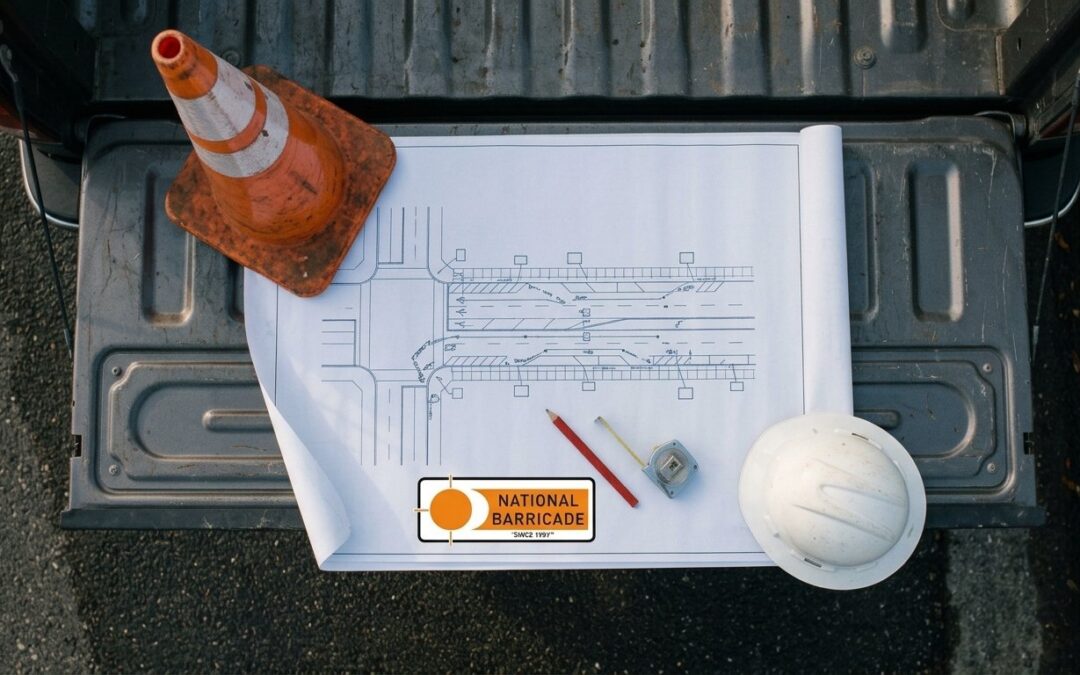
A traffic control plan — you’ll see it written as a TCP — is a scaled drawing showing how traffic, pedestrians, bikes, and transit will move through or around your work zone while you’re in the right of way.
It is not the same thing as your permit. It’s an attachment to it. You apply for a street use permit, and if your work meets certain conditions, SDOT requires a TCP alongside the application before they’ll approve anything.
The plan has to show where every sign, cone, barricade, and channelizing device goes, how wide the remaining travel lanes will be, where pedestrians get routed, and who to call at 2 a.m. if something in the work zone goes wrong.
Four questions that tell you whether you need one
Seattle doesn’t require a plan for every job in the right of way. Per SDOT’s Client Assistance Memo 2111, you need one if you can answer yes to any of these:
There’s also a catch-all: SDOT can require a plan any time they judge the mobility impact to be significant. When your job is close to the line, assume yes and plan for it.
What SDOT expects on the plan
This is where most rejections come from. Not a bad traffic control concept — a plan that’s missing required elements. SDOT’s checklist breaks into three parts, and the city documents the process in Streets Illustrated.
The title block
- Project address and a description of the work
- Work hours and non-work hours, plus the project phase
- The words “Traffic Control Plan,” the permit number, and the hours the setup will be in place
- A 24-hour contact — a name and a phone that will actually be answered
- North arrow and a scale bar, with 1:20 to 1:60 preferred
- The standard notes covering curb space reservations, haul routes, transit coordination, sidewalk requirements, advance warning signs, lane widths, and flaggers
The base map
Before you draw a single cone, the plan has to show what’s already there:
- Existing channelization — lane lines, lane widths, crosswalks, curb lines, sidewalks, and right-of-way limits
- Business access points and driveways
- Bike facilities
- Transit zones and bus stops
- Anything blocking sight lines
- How the curb space is currently designated — paid parking, load zones, no parking
The traffic control itself
- The work zone footprint, dimensioned
- Pedestrian detour routes
- Any bike lane closures and how riders get around them
- Minimum 11-foot lane widths where a single lane stays open
- Alternate access for any property you’re blocking
- Temporary sign locations
- Channelizing device placement, with spacing called out
- Flagger and uniformed police officer positions
That device spacing line is the one that trips people up. It isn’t enough to say “cones here.” The plan has to show how many and how far apart, and the count on the drawing is the count you need on the truck.
One thing to handle early: transit
If your work zone touches a bus stop or a transit route, King County Metro needs advance notice — generally five to ten working days before you start. That’s a separate conversation from your SDOT submittal, and it runs in parallel, not after. Contractors who wait until the permit is approved to call Metro lose another week.
How long review actually takes
The Seattle Traffic Control Manual allows up to 10 working days for the engineer to review and approve a plan. That’s two weeks on the calendar, assuming your submittal is complete.
Assuming is doing a lot of work in that sentence. Under heavy permit volume, SDOT has quoted substantially longer turnarounds — permits that include a traffic control plan have run several times longer than permits without one. An incomplete submittal restarts the clock.
Two practical takeaways:
Submit earlier than feels necessary. If your plan needs a revision, you want that discovered in week two, not week six.
Reserve equipment on the plan’s timeline, not the permit’s. The gear your plan specifies is the gear you’re committed to. If your approved TCP calls for eight Type III barricades and a message board, showing up with six barricades isn’t a small deviation — it’s an unapproved work zone.
Equipment That Meets The Plan
Every element on an approved plan corresponds to something physical on the street. Once SDOT signs off, that drawing is the standard your site gets inspected against. Working backward from a typical Seattle plan:
| Plan element | What it means on site |
|---|---|
| Advance warning sign sequence | Construction signs on stands, placed at the spacing your plan shows |
| Channelizing devices with spacing | Cones, delineators, or drums, in the quantity the drawing calls for |
| Lane closure taper | Barricades and channelizing devices through the taper |
| Hard separation from the work zone | Water-filled barriers where positive protection is required |
| Public messaging on an arterial | An electronic message board |
| Curb space reserved | Temporary no-parking signs, posted in advance |
| Pedestrian detour | Barricades, signs, and a compliant walkway |
If you’re building out a full work zone rather than a single closure, our work zone safety equipment page covers what a complete setup includes.
Count the devices on your approved plan before you call anyone for a quote. It’s a five-minute exercise that prevents the most common problem we see — a crew on site at 6 a.m. one barricade short of a compliant work zone.
Frequently asked questions
Do I need a traffic control plan for work on a residential street?
Often not — many residential jobs can use a standard sketch from the Seattle Traffic Control Manual instead of a custom plan. But if the street is classified as an arterial, or you can’t make your setup match any of the typicals, a plan is required regardless of how quiet the street looks.
Who is allowed to prepare a traffic control plan in Seattle?
SDOT doesn’t require a specific license to draw one, but the plan has to meet every element on their checklist and be drawn to scale. Most contractors either have someone in-house who does them regularly or hire a firm that specializes in TCP preparation. We supply the equipment a plan calls for — we don’t draft plans.
How long is an approved traffic control plan good for?
Your plan is tied to the permit and the work hours shown in the title block. If your schedule shifts, your phasing changes, or the work zone footprint moves, you’re looking at a revision — which means going back through review.
What happens if my work zone doesn’t match the approved plan?
Inspectors compare the street to the drawing. A work zone that doesn’t match can be shut down until it’s corrected, and repeat problems affect future permits. This is the single best argument for confirming your equipment count against the plan before mobilization day.
Does a traffic control plan cover temporary no-parking?
Not automatically. Reserving curb space is a separate permit with its own rules — including posting signs well in advance of the reservation. Handle it alongside your TCP, not after.
Plan first, then call us
The sequence that works is straightforward: figure out whether your job triggers a plan, get the plan drawn and submitted with time to spare, and reserve equipment against what the approved drawing specifies.
We’ve been the equipment side of that sequence in Western Washington since 1951 — three generations, three yards in Seattle, Marysville, and Auburn, fully licensed by the Washington State Department of Transportation, and 24-hour emergency response for when a job doesn’t go according to plan. If you’re working outside the city, we cover King County and the rest of the Puget Sound region — see our rental program for how delivery works. More permit and work zone guides are in our resources library. Reserving curb space too? Read Temporary No Parking Signs in Seattle.
Bring Us Your Approved TCP
We’ll help you turn the drawing into a device list — short-term or long-term, delivered to your site. Serving Seattle, Tacoma, the Eastside and Snohomish County since 1951.